LEAP 71's 200 kN Aerospike Engine to Power Aspire Space's Oryx Spacecraft
The XRA-2E5, the world’s largest 3D-printed aerospike engine, marks the first major propulsion hardware milestone for Aspire’s fully reusable launch system. Hot-fire testing scheduled for later this year.
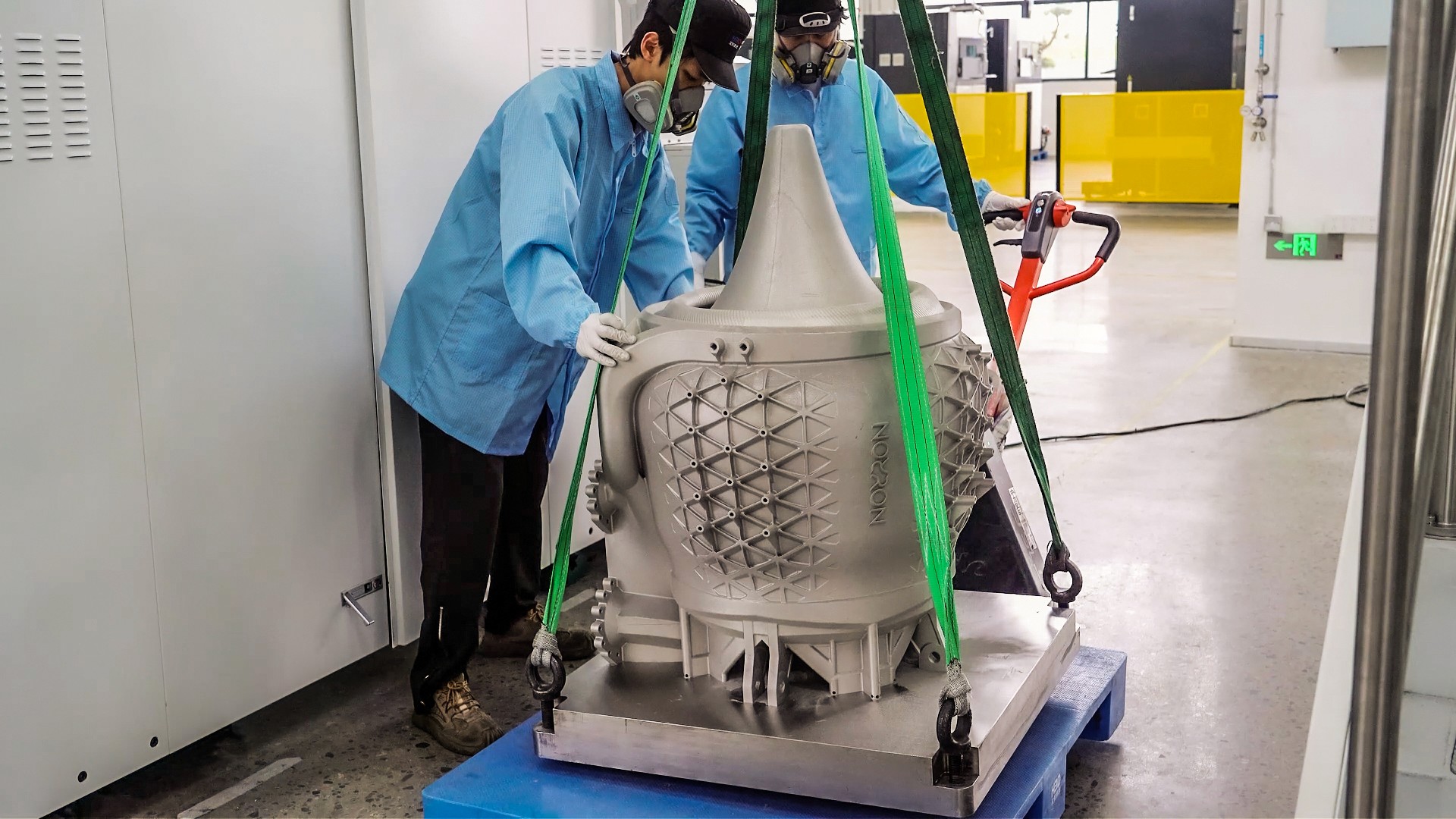
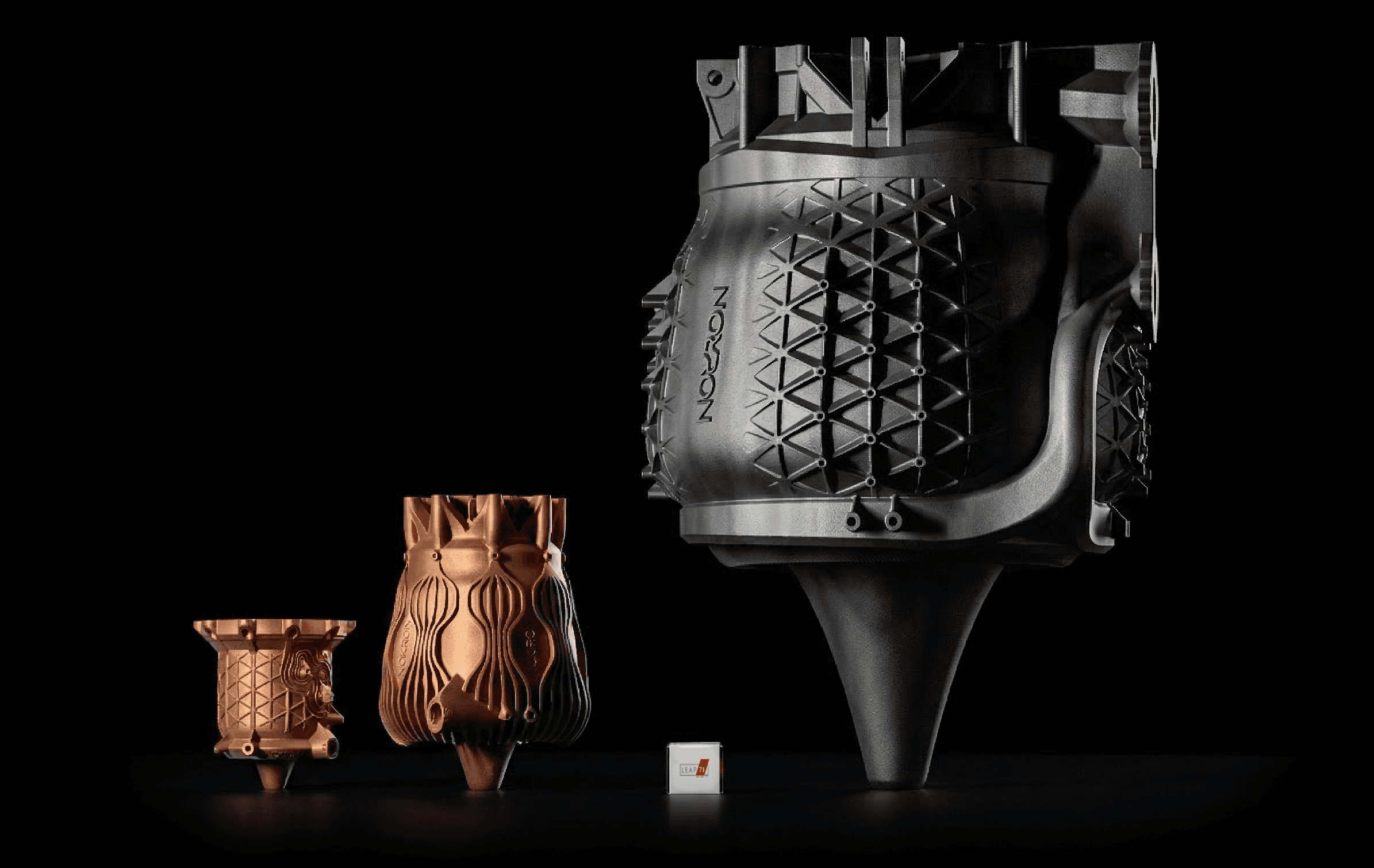
UAE / SHANGHAI, March 14, 2026 — LEAP 71 and Aspire Space today announced that the XRA-2E5 — a 200 kN aerospike rocket engine designed to power the upper stage of Aspire’s fully reusable Oryx spacecraft — has been successfully manufactured. Produced by HBD (Shanghai Hanbang United 3D Tech Co., Ltd.) using large-format metal additive manufacturing, the one-metre-tall cryogenic methalox engine is the world’s largest 3D-printed aerospike to date.
The XRA-2E5 was engineered using Noyron, LEAP 71’s Large Computational Engineering Model, which generates fully manufacturing-ready designs from first-principles physics and engineering logic without manual design steps.
HBD printed the engine as a monolithic Inconel 718 structure in 289 continuous hours on the HBD 800, a ten-laser powder-bed fusion system with one of the largest build volumes in commercial metal additive manufacturing. The engine was produced on the first build.
Aerospike engines differ from conventional bell-nozzle designs in a fundamental respect: rather than being optimised for a single altitude, they maintain high efficiency from sea level to vacuum. The exhaust plume expands along a central spike and self-adjusts as external pressure changes.
This makes aerospikes particularly well-suited to the upper stage of a fully reusable launch vehicle, which must perform efficiently through the upper atmosphere and into orbit before returning to the launch site.
The XRA-2E5 uses a regenerative cooling architecture — the outer chamber is cooled by cryogenic methane, and the central spike by liquid oxygen — to manage the intense thermal loads of the combustion environment.
The engine shares its design lineage with two earlier Noyron-generated aerospike engines that LEAP 71 has hot-fired over the past 15 months. Those prior test campaigns validated the core design approach at smaller thrust classes; the XRA-2E5 scales that validated architecture to the thrust level required for Aspire’s second stage.
“
Aerospikes are often considered the holy grail of space propulsion. They promise major performance advantages over conventional engines, but their complex geometry has historically made them extremely difficult to design, manufacture and operate. We believe that by combining computational engineering with advanced additive manufacturing, we can finally make them fly. The XRA-2E5 is the hardware proof of that thesis, and Aspire Space’s mission is the destination for it.
Josefine Lissner CEO and Co-Founder of LEAP 71
Aerospikes are often considered the holy grail of space propulsion. They promise major performance advantages over conventional engines, but their complex geometry has historically made them extremely difficult to design, manufacture and operate. We believe that by combining computational engineering with advanced additive manufacturing, we can finally make them fly. The XRA-2E5 is the hardware proof of that thesis, and Aspire Space’s mission is the destination for it.
Josefine Lissner CEO and Co-Founder of LEAP 71
“
The XRA-2E5 is a significant milestone for Aspire and for our propulsion roadmap. We set out to develop a second-stage engine that matches the technical ambition of a fully reusable launch system, and that is what LEAP 71 and HBD have produced. The combination of an aerospike nozzle, computational design, and additive manufacturing is exactly the kind of step-change approach that our programme requires. We are looking forward to seeing it perform on the test stand.
Stan Rudenko CEO of Aspire Space
The XRA-2E5 is a significant milestone for Aspire and for our propulsion roadmap. We set out to develop a second-stage engine that matches the technical ambition of a fully reusable launch system, and that is what LEAP 71 and HBD have produced. The combination of an aerospike nozzle, computational design, and additive manufacturing is exactly the kind of step-change approach that our programme requires. We are looking forward to seeing it perform on the test stand.
Stan Rudenko CEO of Aspire Space
What Comes Next
The XRA-2E5 is currently being exhibited at TCT Asia in Shanghai (Hall 7.1, Booth 7E35) before proceeding to acceptance checks and integration into a dedicated test stand. A full hot-fire test campaign is scheduled for later in 2026 to validate engine performance across its full operating envelope, with results informing the engine configuration for the Oryx second stage and Aspire’s broader propulsion roadmap.
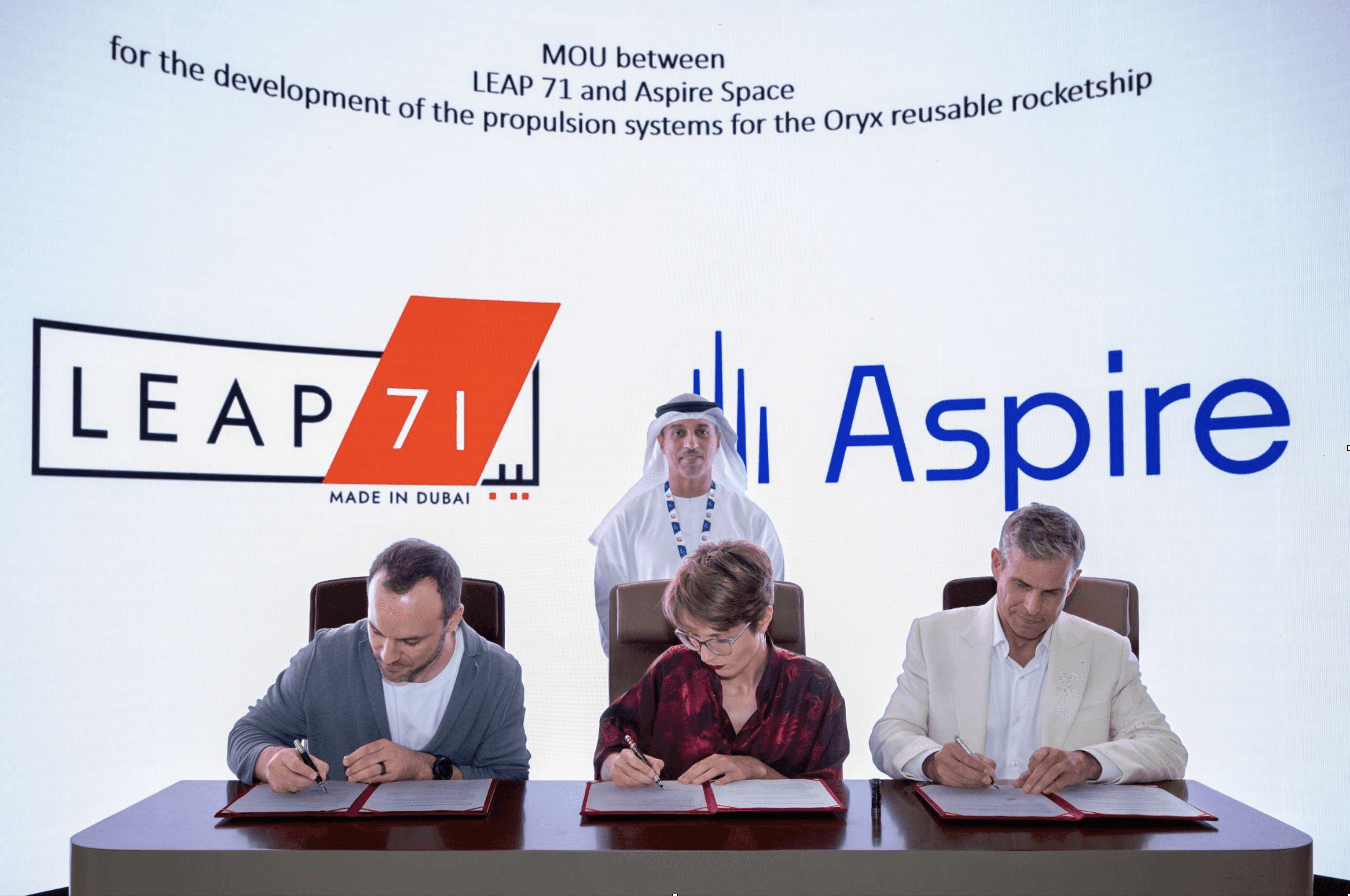
The XRA-2E5 is the first engine produced under the multi-year propulsion development agreement between Aspire Space and LEAP 71, announced in November 2025. Under that agreement, LEAP 71 is developing a full spectrum of propulsion systems for the Oryx vehicle, spanning both stages of the fully reusable launch system.
About Aspire Space
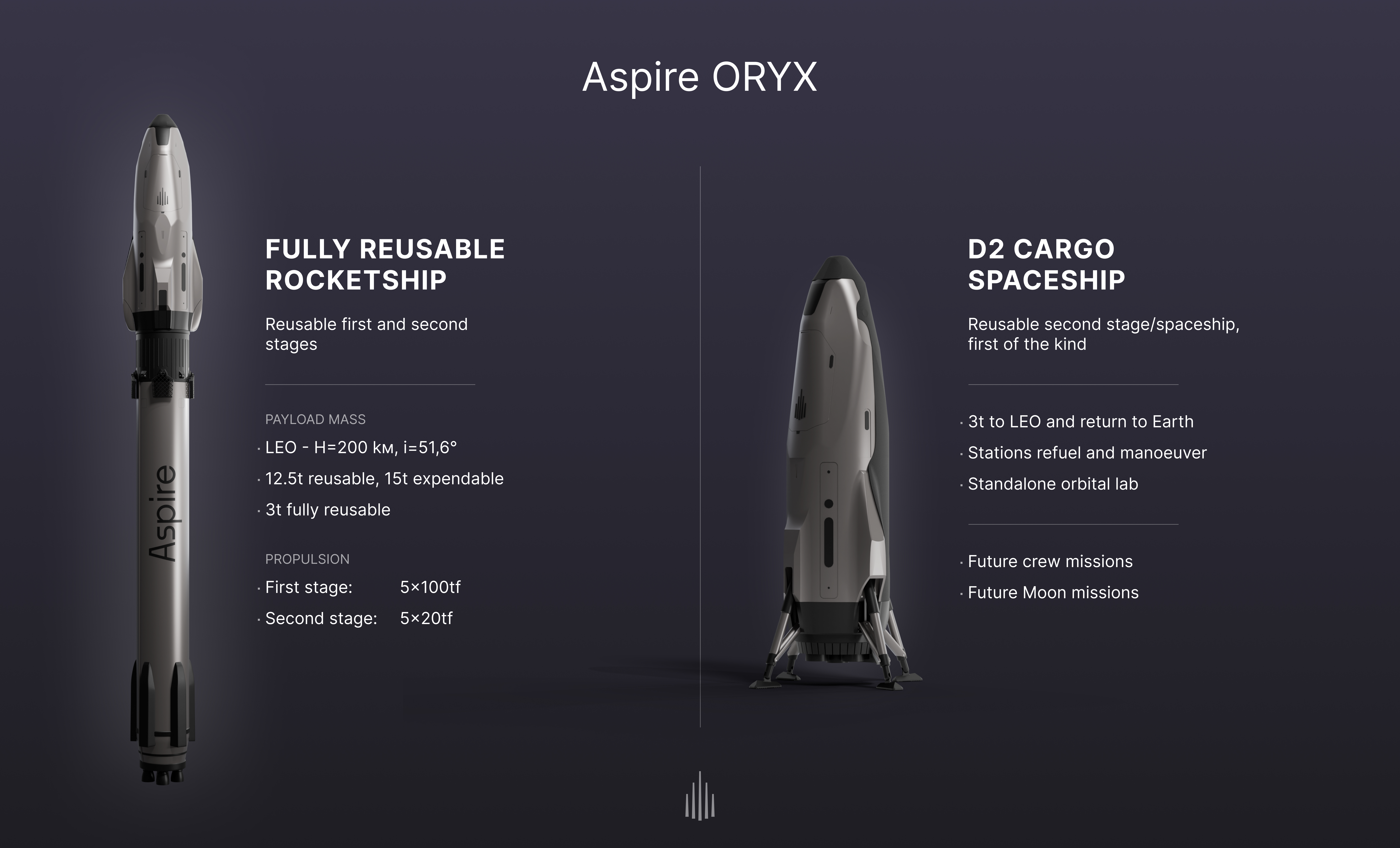
Aspire Space is a UAE-headquartered space transportation company developing the Oryx, a fully reusable launch vehicle and spacecraft. The company’s mission is to provide reliable, high cadence access to orbit for commercial, institutional, and sovereign customers.
Aspire Space is building toward an inaugural launch and is focused on developing a reusable launch architecture that substantially reduces the cost of reaching orbit.
LEAP 71 was founded on the vision that radically accelerating real-world engineering is essential to shaping the future of humankind. Strategically based in Dubai, UAE, the company works with customers worldwide to design advanced machinery across aerospace, electric mobility, robotics, and thermal systems.
A pioneer in the emerging field of Computational Engineering, LEAP 71 designs physical objects autonomously — without manual modeling or human input. At its core is Noyron, a Large Computational Engineering Model that encodes logic, physics, production methodologies, and real-world feedback into a coherent, deterministic system. It has been called “the first AI that builds machines.”
Noyron generates functional designs in seconds or minutes, optimized for modern manufacturing technologies such as industrial 3D printing.
A key focus for the company is extending humanity’s footprint in space. LEAP 71 is developing a spectrum of reference designs for space propulsion systems that serve as the DNA for customer-specific engines. Frequent physical testing and validation continuously enrich Noyron’s models.
LEAP 71 was founded in 2023 by aerospace engineer Josefine Lissner and serial entrepreneur Lin Kayser.